


Number of bikes
4
Own weight
Ca. 19.5 kg
Foldable
✗
Tiltable
✓
Amber IV
This lightweight bike carrier is designed for transporting 4 bikes.
The Amber IV is easy to place on the tow bar thanks to the patented quick-release coupling. On this bike carrier, bikes are securely fastened in wide, stable plastic wheel holders. There is no load on the bike's crankset due to frame attachment.
The lighting works via a combined 7/13-pin (Jaeger) plug, including rear fog light and reversing light (via 13-pin plug).
The boot remains accessible due to the easy-to-operate tilt mechanism and the bike carrier is lockable with a padlock.
Pro-User advises to not mount this bike carrier on a campervan due to the strain on the towing system.
Specifications for the
Amber IV
| Number of bikes | 4 |
| Own weight | Ca. 19.5 kg |
| Expandable | ✗ |
| Max. carrying load | 60 kg |
| Dimensions unfolded | 102 x 83 x 72 cm |
| Dimensions when folded | 102 x 19 x 72 cm |
| Max. wheelbase | 65-120 cm |
| Bike frame circumference | Max. 30 cm |
| Maximum bicycle tire width | 8 cm |
| Wheel holder distance | 18 cm |
| Fitting to a tow bar | Lever |
| Type of plug connection | 7- and 13-pin plug |
| Mounting of bicycle frame | Frame holders with lashing straps |
| Lighting | Halogen |
| Color | Black |
| Warranty | 3 years |
| Optional | Wall bracket |
| Transport wheels | ✗ |
| Suitable for E-Bikes | ✗ |
| Wheel protection | ✗ |
| Anti-theft lock | ✗ |
| Tiltable | ✓ |
| Extendable | ✗ |
| Fixed frame holders | ✗ |
| Removable frame holders | ✓ |
| Single-key system | ✗ |
Bike carriers general
The clip on the wheel holder strap is coming loose. What should I do?
When fastened properly, it cannot come loose. If it does, the clip is the wrong way round and simply needs to be flipped over (turned 180 degrees).

What is the difference between the FG2 and FG2 Plus?
Moving frame holders on the carrier: how do I do that?
The lift on my Bike Lift isn't working. Why could that be?
The bike carrier is equipped with a lock; does it need to be locked?
The bike carrier is sitting crooked on the towbar. What should I do?
-
Because the majority of towbars are fitted by the dealer, they may not always be adjusted properly to be level. Bike carriers centre themselves on the neck of the towbar. Therefore, if the towbar has a deviation, you will see this reflected in the bike carrier, causing it to sit at an angle.
-
Another cause could be that your car is loaded in such a way that it leans to one side and/or sags at the rear. This can also cause the bike carrier to show a deviation.
DIN 74058 regulations describe the installation of a towbar. Explanation: by this, we mean that the axis is parallel to the vertical plane. This ensures the towbar neck is perfectly straight, which the bike carriers use to centre themselves.
Example 1: when the towbar is fitted at a vertical 90° angle:

The bike carrier is tilted slightly (2°) towards the car. This is done to keep the bike carrier horizontal when it is loaded with, for example, two heavy electric bikes.
Example 2: when the towbar is fitted at a vertical 85° angle:

Due to a 5° deviation in the towbar, the bike carrier is no longer vertically straight. As a result, the bike carrier starts to lean backwards as shown in the image. Please contact your car dealer to have the towbar checked in order to prevent damage to the bike carrier.
Example 3: when the towbar is fitted at a horizontal 90° angle:

When the neck of the towbar is perfectly straight, the bike carrier is also positioned perfectly horizontally behind the car.
Example 4: when the towbar is fitted at a horizontal 89° angle:

As soon as the neck of the towbar has a deviation of just 1°, you will notice that the bike carrier tilts to the left. This 1° deviation results in a difference of roughly 1 to 3 cm in height between the left and right sides of the bike carrier.
Example 5: when the towbar is fitted at a horizontal 85° angle:

With a larger deviation, this results in a drastic deviation of roughly 6–8 cm. We would therefore like to point out that this can pose a safety hazard for you and other road users. Please contact your car dealer to have the towbar checked and/or adjusted.
Can the quick-connector be adjusted?
Can accessories be left on the bike during the ride/journey?
During the ride, they recommend having no accessories on the bike, which means no: panniers, batteries, child seats, covers, etc.
The lights on my bike carrier aren't working properly, what should I do?
Check the wiring of the bike carrier. Check whether the wires inside the plug have accidentally come loose. If you have checked this and it does not solve the issue, the bulb in the bike carrier may need replacing.
Please note: on the Amber I, II, III and IV, the light unit with the rear fog light is fitted on the left-hand side of the bike carrier.
Is this bike carriers suitable for electric bikes?
My bike does not fit on my bike carrier. How is that possible?
Check the wheelbase and tyre width in the specifications of your bicycles and the bike carrier.
| Amber I | Maximum bicycle tyre width: 60 mm Maximum wheelbase: 1250 mm |
| Amber II | Maximum bicycle tyre width: 8 cm Maximum wheelbase: 65 to 120 cm |
| Amber III | Maximum bicycle tyre width: 8 cm Maximum wheelbase: 65 to 120 cm |
| Amber IV | Maximum bicycle tyre width: 8 cm Maximum wheelbase: 65 tot 120 cm |
| Diamant I | Maximum bicycle tyre width: 6 cm Maximum wheelbase: 125 cm |
| Diamant FG2 | Maximum bicycle tyre width: 8 cm Maximum wheelbase: 135 cm |
| Diamant FG2 Plus | Maximum bicycle tyre width: 8 cm Maximum wheelbase: 135 cm |
| Diamant FG3 | Maximum bicycle tyre width: 8 cm Maximum wheelbase: 135 cm |
| Diamant SG2 | Maximum bicycle tyre width: 5,5 cm Maximum wheelbase: 125 cm |
| Diamant SG2 Fix4Bike | Maximum bicycle tyre width: 5,5 cm Maximum wheelbase: 125 cm |
| Diamant SG3 Fix4Bike | Maximum bicycle tyre width: 5,5 cm Maximum wheelbase: 125 cm |
| Briljant | Maximum bicycle tyre width: universal Maximum wheelbase: 47 cm |
| Diamant Bike lift | Maximum bicycle tyre width: 6,5 cm Maximum wheelbase: 125 cm |
Which bike carrier is suitable for a FIX4BIKE tow bar?
Do you own a car with a FIX4BIKE tow bar (recognisable by the two bolts on the side of the tow bar) and are you looking for a suitable bike carrier? Pro-User bike carriers has equipped two bike carriers specifically for these tow bars with a special FixMatic coupling:
This coupling ensures that the bike carrier always fits securely and straight onto the tow bar.

A bike carrier fitted with a standard coupling will also fit this type of tow bar, but for the most secure attachment, we recommend a FixMatic bike carrier.
Where should I keep the bike carrier when I’m not using it?
Many bike carriers are quite large in size, which makes them rather awkward to store when not in use. While solutions such as a wall mount or wall bracket are available for this, the best option is actually a foldable bike carrier. Several bike carrier manufacturers now offer partially or fully foldable models, compact in storage, yet full-sized on the tow bar.
Heb ik wel toegang tot mijn kofferbak bij een gemonteerde trekhaak fietsendrager?
If you frequently need to load or unload luggage while a tow bar mounted bike carrier is fitted, easy boot access is a must. In this case, tilting bike carriers are an ideal solution, allowing you to tilt the carrier (complete with bikes) away from the vehicle so you can easily open the boot.
Unfortunately, it is impossible to give a 100% guarantee that a tilting bike carrier will always provide enough clearance to open the boot or tailgate. Different manufacturers of tow bar mounted bike carriers use different designs, and vehicles themselves vary considerably. This is partly because different trim levels or versions of a specific make, model, and year can have varying boot or tailgate dimensions (due to optional accessories, for instance). Furthermore, clearance heavily depends on the brand and type of tow bar fitted (detachable or fixed). One brand of tow bar may have a different distance between the tow ball and the bumper (or chassis) than another, as well as a different tow ball height.
Tow bar system dimensions for passenger cars are standardised under ISO 1103:
-
The standardised clearance between the bumper (the rear exterior of the car) and the tow ball must be at least 65 mm, though there is no specified maximum, manufacturers are free to exceed this, leading to significant differences. This 65 mm clearance is measured from the surface of the car (the bumper or rear bodywork) at the height of the tow ball to the centre of the ball.
-
The standardised height of the tow ball must be between 350 mm and 420 mm, measured from the road surface to the centre of the ball. These tolerances are so wide that it remains difficult to offer a 100% guarantee that the tailgate will clear the carrier in every setup.
Staan de fietsen goed vast?
In general, the bikes sit securely in sturdy wheel holders. The wheels are then secured to these holders using wheel straps. If you want to be certain that the bikes will not budge, opt for a bike carrier where you can fasten the wheels using ratchet buckles. These allow the wheels to be locked firmly in place. The bike frame is generally secured to an upright support bar fitted with frame clamps or strap frame holders.
There are two different types available:
- Clamp frame holder: The most common way to secure a bike frame is by using the frame holders. The bike frame is placed into the frame clamp or strap holder, which is then tightened and locked using a rotary knob. This solution with clamps is often unsuitable for carbon bike frames.
- Lash or strap frame holder: Several bike carrier manufacturers use a strap frame holder. With this system, the bike frame is secured by wrapping a synthetic strap (sometimes reinforced with a metal insert) around the frame and fastening it via a buckle.
Is de fietsendrager gemakkelijk op de trekhaak te bevestigen?
In general, a bike carrier is fairly easy to fit onto the tow bar, particularly if it features a so-called quick-release coupling. Not only does this make mounting it onto the tow bar straightforward, it also requires less physical effort. In addition, most tow bar mounted bike carriers are lockable.
Past elke trekhaak fietsendrager altijd op elke trekhaak?
The tow bars we use in Europe are standardised in a number of ways. This means that every tow bar manufacturer has to comply with certain statutory regulations: the tow ball has a diameter of 49.61–50 mm and the tow bar neck has a diameter of 27–29 mm. These dimensions allow manufacturers of tow bar mounted bike carriers to offer a universal bike carrier.
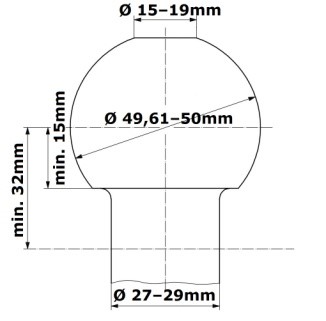
However, there are a few exceptions. There are a number of special "bike carrier hitches" on the market that may only be used in combination with a bike carrier. They must not be used to tow a trailer or caravan, so strictly speaking, you cannot really call them a tow bar. Because hybrid car drivers still like to use a bike carrier, and doing so is permitted, various tow bar manufacturers have devised a solution, which is executed differently by each brand.
Aside from whether the tow bar mounted bike carrier fits onto the tow bar (which will be the case 98% of the time), it is vital to respect the maximum nose weight of the tow bar. This nose weight (vertical load) is stated on the tow bar's data plate, is included in its type approval, and must not be exceeded by law. The tow bar's data plate can usually be found next to the electrical socket. If not, please consult your car dealer. At present, the tow bar's nose weight is the only reference point for the maximum load capacity of the tow bar when using a bike carrier. Strictly speaking, this is not entirely accurate (this is currently being looked into at a European level), but to date it remains the only legal reference and must be adhered to. This maximum nose weight, along with the towing capacity, is determined by the vehicle manufacturer and the tow bar manufacturer based on numerous factors, such as how the tow bar is mounted to the car, the vehicle's chassis, engine power, suspension, and handling characteristics. Furthermore, a tow bar is subjected to greater stress when used with a tow bar mounted bike carrier than when towing a trailer. It is therefore very important to know whether the car you intend to use with a loaded bike carrier is actually suitable. Many popular smaller cars only have a nose weight limit of 50 kg, which puts transporting two electric bikes into the danger zone. The weight of most electric bikes can be reduced by removing the battery from the bike (where possible).
PLEASE NOTE: When calculating the maximum nose weight load, you must of course add together the weight of the bikes as well as the unloaden weight of the bike carrier itself!
Ik ben op zoek naar een fietsendrager, waar moet ik op letten?
There are several ways to safely transport a bicycle by car. The most common solutions are:
- Tow bar mounted bike carriers
- Roof-mounted bike carrier (on roof bars)
- Rear-mounted bike carrier (hanging on the tailgate/boot lid)
- Interior bike carrier
- Integrated bike carrier
Although the tow bar mounted bike carrier is the best-selling option, here is more information about the other solutions:
Roof-mounted bike carrier (on roof bars): A roof-mounted bike carrier is generally cheaper than a tow bar mounted bike carrier, though there are a few drawbacks: To fit a roof-mounted bike carrier, you first need to purchase a set of roof bars. For cars with roof rails, more universal roof bar sets are available, whereas for most other cars, you will need to buy a vehicle-specific set. These are often expensive and will only fit that particular vehicle. With a roof-mounted bike carrier, you can usually only transport one bike. If you want to take extra bikes on the roof, you will need to fit an additional carrier. Be sure to pay close attention to the maximum load capacity of both the roof and the roof bars.
When using a roof-mounted bike carrier, the bikes always have to be lifted high up. Because of this, this solution is essentially unsuitable for transporting electric bikes. Furthermore, the bike sits high up on the car, meaning it catches a lot of wind. This not only creates more resistance, but also increases fuel consumption. You also need to constantly bear in mind the total height of your vehicle, for instance, when entering a tunnel or a multi-storey car park. The advantage of a roof-mounted bike carrier is that the boot remains completely accessible and any existing tow bar stays free for a trailer. Additionally, it is a relatively straightforward solution if the car is not fitted with a tow bar.
Rear-mounted bike carrier (tailgate/boot lid): A rear-mounted bike carrier is also generally cheaper than a tow bar mounted bike carrier. The carrier hangs on the tailgate or boot lid and is secured using synthetic or metal straps. Because the carrier rests against the rear of the car, there is a risk of scratching the paintwork. Rear-mounted bike carriers are generally not universal. Due to the many different tailgate designs on modern cars, it is crucial to check in advance not only whether your car is suitable for a rear-mounted carrier, but also whether the specific carrier fits your car's tailgate. Generally speaking, a tailgate cannot bear too much weight, meaning this solution has very limited applications and is primarily intended for road bikes. The main advantage, however, is that it is a relatively easy and inexpensive solution if your car does not have a tow bar.
Interior bike carrier: There are several bike carrier systems available for transporting bicycles inside the car. This is an ideal solution if you do not have a tow bar, provided you have a large load space. It is the only solution where the bike is completely protected from all weather conditions. A major drawback is that the bike has to be partially dismantled (removing the front wheel), which severely limits its use, meaning it is really only used for transporting road bikes or mountain bikes.
Integrated bike carrier: There are a few vehicle systems where the bike carrier is fully integrated into the bodywork of the car. The great advantage is that the carrier is always available and ready for use. It simply needs to be slid out and unfolded, and the bikes can be loaded straight onto it. This is arguably the most user-friendly bike carrier, though there are some disadvantages: Because the carrier is built into the car, it cannot be transferred to another vehicle. It is also relatively expensive and limited to carrying a maximum of two bikes. Since the carrier is permanently housed inside the car, it takes up space that could otherwise be used as boot space. Furthermore, it is no longer possible to have a tow bar fitted.
Tow bar mounted bike carrier: The tow bar mounted bike carrier is the best-selling type of bike carrier in the country. Its high load capacity, ease of loading, and universal fit on virtually any tow bar make it the most popular choice. Because there is such a wide range of tow bar mounted bike carriers available, here is an overview of what to look out for when buying one:
-
Is every tow bar mounted bike carrier suitable for transporting every bike? There are so many different types of bikes and bike carriers on the market that it is impossible to give a 100% guarantee that every bike will fit every carrier. It is therefore vital to determine in advance which bikes you plan to transport. Aside from whether the bikes physically fit, you must also consider the maximum load capacity of the carrier, the nose weight (vertical load) of the car's tow bar, and the construction and material of the bike (such as carbon-frame bikes).
-
How many bikes do you want to transport? Most tow bar mounted bike carriers on the market are designed to carry two bikes. However, there are also models available for transporting 1, 3, or even 4 bikes. It goes without saying that a 4-bike carrier is not intended for electric bikes, but rather for lightweight bicycles (or a combination including one or two children's bikes). Some manufacturers also offer carriers that can be extended to carry 3 or even 4 bikes.
-
What type of bikes do you want to transport? Virtually all bike carriers are suitable for standard city and touring bikes. In addition, there is a growing range of carriers specifically designed for electric bikes. If you primarily intend to transport two e-bikes, choose a carrier built specifically for this purpose. These carriers typically feature a reinforced frame, wider spacing between the wheel trays, and a higher maximum load capacity (usually around 60 kg). They can also often be fitted with handy accessories such as a loading ramp to easily wheel the bikes onto the carrier, and there are even models available with a built-in lift system. If you mainly want to transport mountain bikes, you will need a carrier with wider wheel trays. If you own a bike with a carbon frame, it is essential to choose a carrier that clamps the bike without putting undue stress on or deforming the carbon frame. Finally, there remains a category of bicycles that cannot be transported on virtually any universal tow bar mounted bike carrier: recumbent bikes, tandems, fatbikes, and tricycles generally do not fit on a standard tow bar carrier, for these, you will need to consult a specialist.
NOTE: There are still a great many bike carriers in use carrying electric bikes, even though those carriers were not specifically designed for them. Particularly in the past, before e-bikes existed, large numbers of bike carriers were manufactured that are still on the road today loaded up with electric bikes (often with the batteries still attached and even panniers left on). While they may technically be within the maximum weight limit, these older carriers were built in an era before electric bikes existed, and the weight distribution of a conventional bike is very different from that of an e-bike. These carriers have never been tested for this. Doing so is genuinely life-threatening! The weight distribution of an electric bike differs considerably from a standard bicycle, particularly when the motor is located in the front or rear hub (a mid-drive motor causes the fewest issues).